

logo
Logo

Edudigital FinAid · Title IV workflow support

Financial aid, built into your student record.

Every number deterministic, explained, and yours to approve. Edudigital FinAid reads the same student, enrollment, attendance and billing records as the rest of your campus, prepares SAP evaluations, R2T4 worksheets and eligibility checks, and stages each result for your staff to review.

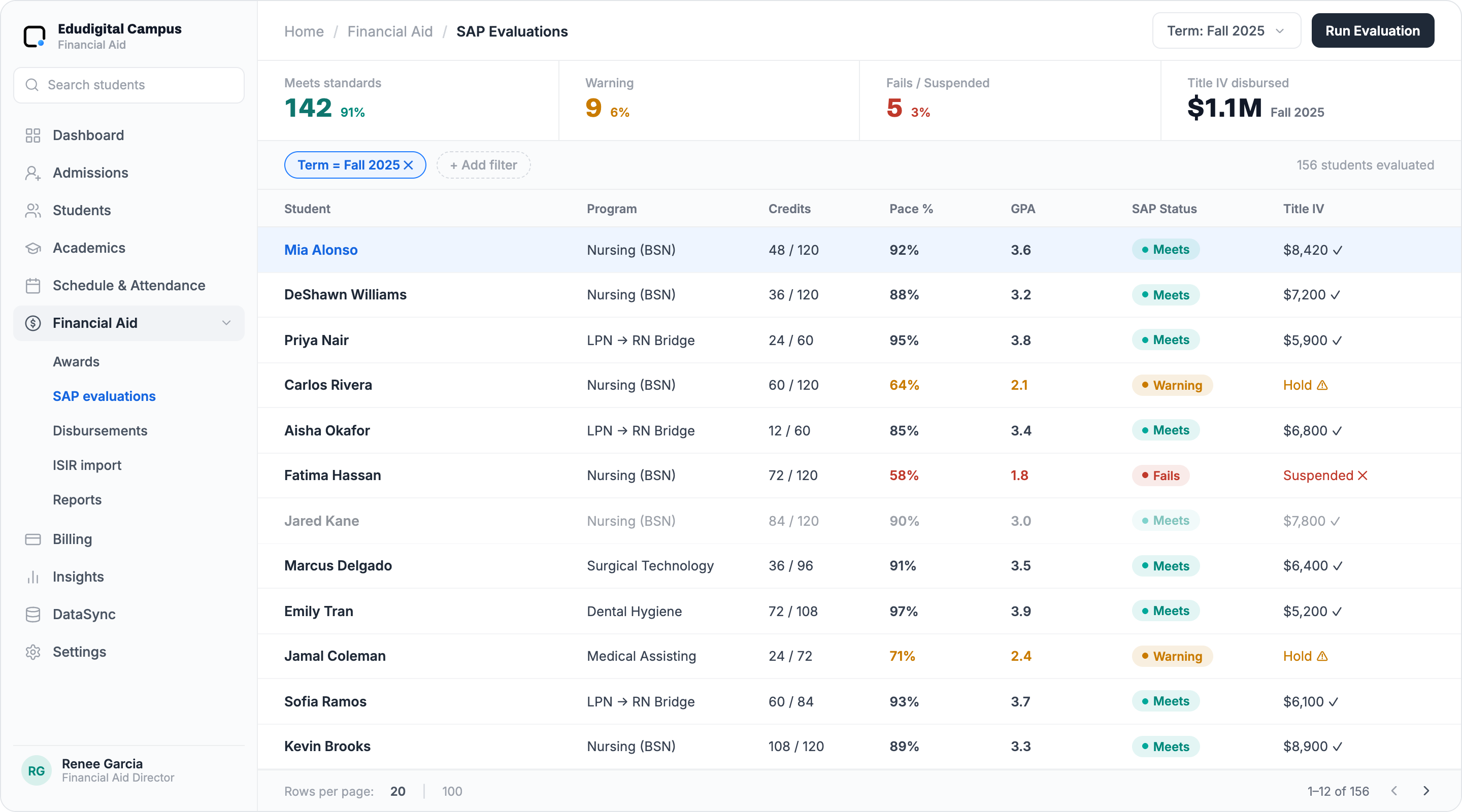
Edudigital FinAid SAP evaluation screen

How it's built

Deterministic. Explainable. Configurable. Predictive.

Four rules behind every screen in the module. The math is fixed and published, every result opens to its proof, your policy is configuration rather than code, and early-warning signals advise without ever deciding.

Deterministic

Every compliance number comes from the published formula and your written policy, run as fixed, ordered steps. R2T4 follows the eleven steps of 34 CFR 668.22, including the rules in effect since July 1, 2026. SAP evaluates GPA, pace and maximum timeframe under 34 CFR 668.34. No model and no AI sets an award, a return or a SAP status.

Explainable

A SAP status, an R2T4 result or an eligibility decision opens to the rule version applied, the inputs used, the citation, and who approved it. Records are append-only: a correction creates a new versioned entry beside the original, and re-running a past term applies the rule that was in force then.

Configurable

The federal rule is fixed. Your choices inside it, from SAP thresholds and evaluation points to warning and probation use, appeals, schedules and cost-of-attendance components, are settings your compliance administrator maintains, each with an effective date and its own test cases. When federal rules change on July 1, they arrive as dated versions you can review before they take effect.

Predictive, advisory only

Signals flag students heading toward a SAP problem, withdrawal risk, and verification files likely to stall, each with the reasons behind it. They rank and warn. They never set a status, an award or a return. Deterministic rules decide, and your people approve.

Rule changes

Rule changes arrive as versions, not surprises.

Federal aid rules change every July 1. In Edudigital, each change arrives as a dated rule version: past results keep the rule that applied then, and new calculations use the new one from its effective date. Proof: the July 1, 2026 R2T4 rules.

Clock-hour programs

Hours in a second payment period count only once the first is completed. One method, applied the same way every time.

Programs offered in modules

A module counts only once the student starts it. No more freeze dates.

Deadlines tracked

Withdrawal documented within 14 days of last attendance, calculation within 30 days, return within 45 days.

Worksheet

Every step visible, with the regulation cited next to it.

What the module prepares

Prepared for your approval, with evidence attached

Each capability stages its result for staff review and records the rule version, the inputs and the citation behind it.

SAP Evaluation & Appeals

GPA, pace and maximum timeframe evaluated at the points your policy sets, staged as Meets, Warning, Probation or Not meeting for staff review. Appeals, supporting documents and academic-plan conditions are tracked on the student record instead of in email threads.

R2T4 Worksheet

A withdrawal or last date of attendance produces a draft worksheet with all eleven steps under the rules in effect since July 1, 2026, including the single scheduled-hours method for clock-hour programs. Staff review and approve it, and the 14-, 30- and 45-day clocks are tracked from there.

Payment-Period & Eligibility Checks

Tracks whether each student has completed the hours and the weeks of the payment period before the next one begins. Before funds are authorized, a read-only checkpoint confirms SAP status, enrollment status, payment-period completion and unresolved ISIR flags. It never moves money, and it keeps one person from both authorizing and disbursing aid for the same student.

ISIR Import & Verification Queue

Import the ISIR files your office receives. Each file is validated and rejected whole if it fails, and comment codes route to the right queue. Verification requests go out in English or Spanish by email, SMS or WhatsApp, and the officer marks each file sufficient.

Determination Ledger

An append-only record of every determination: rule version, input snapshot, citation, approver and timestamp. No role can edit or delete an entry. Any number opens to a plain-language explanation generated from its ledger record, and the full ledger exports whenever you need it.

Compliance Calendar & Work Queue

Obligations that apply to your calendar type, programs and accreditor become dated tasks with an owner and the evidence each one needs. Open items rank by deadline, dollars at risk and students affected, with the rule behind each. When the FA officer changes, a handover packet lists open items, deadlines, policies and where every file is.

By program type

One engine, the right federal method for each program.

Each program carries its own calendar and measurement type, so a clock-hour certificate and a credit-hour degree can run side by side at one institution.

Clock-Hour Career Schools

Your programs run on scheduled hours, so your financial aid does too. Scheduled and completed hours are tracked against each payment period, R2T4 is computed from the schedule you published under the rules in effect since July 1, 2026, and SAP maximum timeframe is measured in clock hours.

Term-Based, Accelerated & Non-Term Programs

Semesters, trimesters, quarters, nonstandard and non-term calendars each get the payment-period rules the regulation defines, configured once per program and applied the same way every time. R2T4 counts calendar days the way the rule defines them, scheduled breaks and approved leaves included.

Workforce Pell & Mixed Institutions

Short governor-approved programs, whether measured in clock hours or credits, use the payment-period and R2T4 method that fits. Clock-hour certificates and credit-hour degrees under one roof: one engine, the right method for each.

What Schools Are Saying

Trusted by Postsecondary & Career-Focused Institutions

Feedback from program directors and administrators who piloted Edudigital.

Edudigital has helped us coordinate the operational details that matter during accreditation preparation: platform access, classroom visibility, admissions workflows, and follow-up. The value is not only the system, but the way the work adapts to how our school actually operates.
Jessica Leon, MBA

Director of Operations, NPTI

NPTI logo
When enrollment numbers, program records, and reporting details are needed quickly, having better visibility matters. Edudigital is helping us move away from last-minute manual work and toward a clearer way to manage student and program information.
Sindy Martinez, MA

Registrar, HIU

HIU logo
Campus operations touch admissions, student records, billing, and compliance at the same time. Edudigital helps connect those pieces so our team can work with better information and fewer disconnected handoffs.
Dariena Perez

Controller, NPTI

NPTI logo

Common questions

What the module does, and what it leaves to you.

Straight answers for financial aid directors, owners and compliance officers.

Your office decides and submits.

Edudigital FinAid does not package awards, generate award letters, originate to COD, draw from G5, report to NSLDS or file the FISAP, and it never connects to a federal system. We make sure every decision is prepared, checked and provable. See how it fits the way your programs are measured.

Campus Operations, Unified

Get practical insights on compliance, enrollment, and student success for career-focused institutions.